A Boy Is Born in Champaran
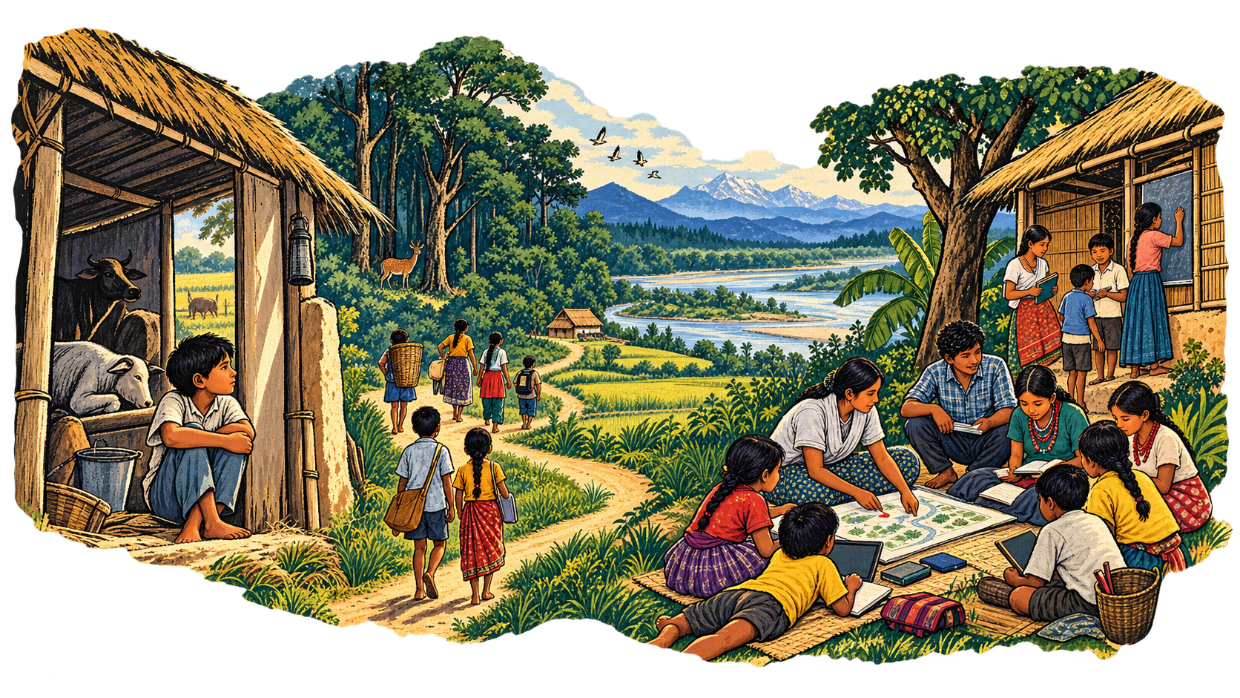
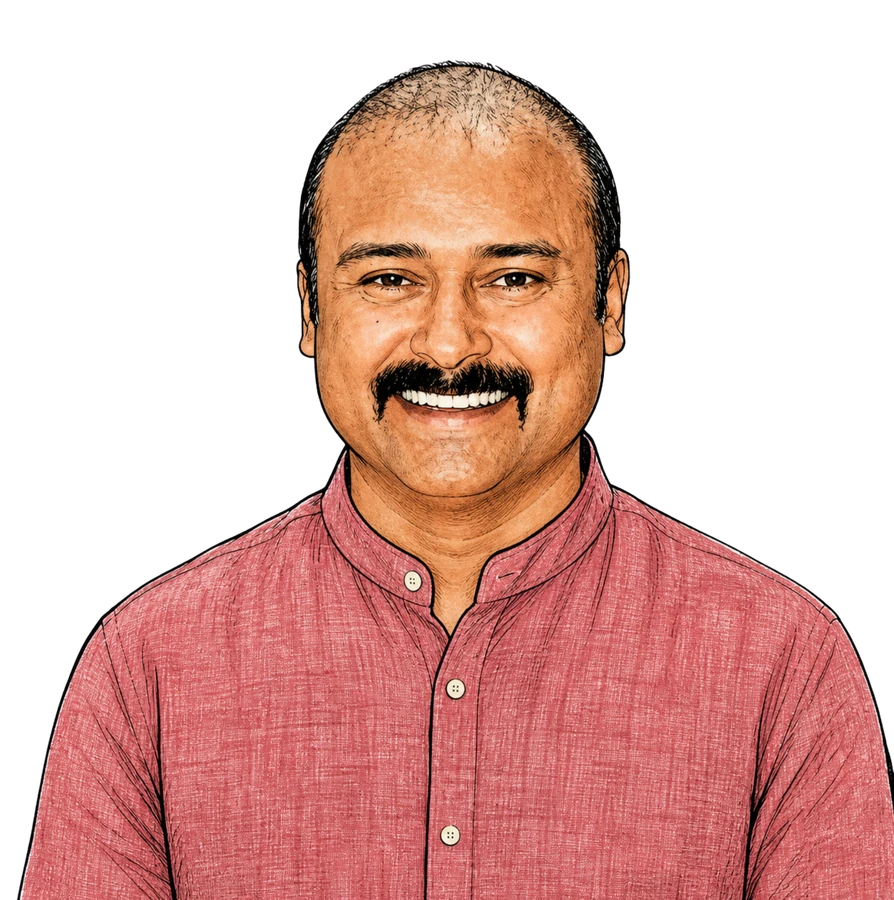
Jitendra Chaturvedi was born on 19 December 1968 in Khairwa, West Champaran - the Bihar countryside that had drawn Gandhi to his first satyagraha half a century earlier.
The register · 1968–2026
Fifty-eight years, told through the moments that changed what came next. Scroll, or move along the ribbon.
A childhood in West Champaran, and the hunger that set the terms for everything after it.
Jitendra Chaturvedi was born on 19 December 1968 in Khairwa, West Champaran - the Bihar countryside that had drawn Gandhi to his first satyagraha half a century earlier.
His father vanished after a dispute, and the prosperous joint family around them closed ranks. His mother and her children were sent out of the house to live in a cowshed. What followed was hunger of the ordinary, daily kind, the sort that leaves no record anywhere.
Food was looked for after midnight: potatoes missed by the harvesters, pumpkins left drying on rooftops. Full-moon nights were avoided. On those nights you could be seen.
Clean water was not shared with them. They drew what they needed from the vessels the cattle drank from, then boiled it and filtered it before anyone in the house would drink.
He worked as a child labourer and a domestic servant to keep himself in school, and made stationery out of discarded paper to sell on the side. Hunger was hidden through the school day and met again at night.
In January 1976 his father came back and moved the family to Bahraich, on the Nepal border. Everything that follows in this history happens within a day’s travel of that town.
He qualified in homoeopathy at Kanpur and later took an MA in Sociology. Medicine is what first put him in a room with other people’s suffering and gave him a reason to be trusted there.
He applied to the Indian Air Force and was rejected at the medical. The family has always read the rejection as the childhood hunger returning to close a door, years after the hunger itself had ended - the Air Force turned him down, but what disqualified him was the malnutrition.
A doctor who charged nothing, Vananchal, a school with no building, and a youth group with no registration number.
He and his life partner moved to Bichhia, at the edge of the Katarniaghat forest, and lived in a thatched house. Most of his patients were forest-dwelling families who could not find fifty paise, let alone a rupee. He treated them anyway, and the practice never became a living.
She carried the household, the money and the uncertainty of a thatched house in a forest region. It was not occasional support. It remained the private infrastructure of his public life for the next thirty-two years.
To feed his own family while treating everyone else for nothing, he wrote, composed and sang folk songs at the gatherings of better-off households. The clinic in the forest was, for several years, funded by singing.
Long before he had any vocabulary of development practice, he had performance and sport. A volleyball match brought young men out; a street play kept them there. Between the two, local injustice became something that could be said out loud in public.
His writing drew interest from the film industry. The fare, the food and the lodging between Bahraich and Mumbai were beyond him, so the scripts stayed where they were written and turned into street plays and songs instead.
A school opened for Tharu and other forest-dwelling children, run out of the same youth group. It was named Vananchal. There was no building and no registration. This is the year DEHAT counts as its beginning, eleven years before it existed on paper. Vananchal is still running, now looked after by Shahid Ali.
After he crossed local interests he was detained, walked through the bazaar in handcuffs and held for five days. The school was destroyed while he was inside and most of the youth group scattered. Thirty years later the same lesson would arrive again: work held by one person can be stopped by removing that person.
He left Bichhia and spent a decade inside voluntary, Gandhian and international health organisations. He came back with method for an instinct he already had: how to run participation, training, documentation and a project that survives an audit.
A society on paper, a study of the forest villages, and a movement the forest dependent communities ran themselves.
On 21 August 2000, the Developmental Association for Human Advancement became a registered society under the Societies Registration Act. The work it was registering was already eleven years old.
Before any campaign, a study. Eight settlements on the banks of Katarniaghat turned out to be missing from revenue and panchayat records altogether: no certificates, no ration access, no secure land, and labour arrangements the residents themselves described as coercive. Hindustan Times and Suchna Express carried it. The state’s answer was that these people were encroachers.
Membership of the Manch was open only to affected residents, which meant DEHAT could not vote in it. Cadres were trained from among the villagers, families paid into a small Gram Kosh, and “Jai Azaadi” became the greeting between them - crossing caste and religion, in a place where neither usually gives way.
While the forest-rights law was being drafted, recommendations from the villages went to the Joint Parliamentary Committee, asking that traditional forest dwellers who are not Scheduled Tribes be included. The final Act includes them. We took part in the advocacy; we have never claimed the clause.
Residents of the forest villages came into Bichhia bazar and demonstrated, not for a scheme or a subsidy, but to be recognised as citizens and given the ordinary rights that follow from it.
Around a thousand children walked through Bahraich to demand schools and anganwadi centres in their own villages, rather than in the villages they were expected to walk to.
Cases had been filed against 123 villagers. The answer was a march, a hunger strike, a mass surrender by the accused, and chulha bandi - evening stoves left unlit across the settlements, so that the hunger was visible and chosen rather than hidden.
Aruna Roy presented the award, given in memory of an IIM graduate and Indian Oil officer shot dead for refusing to let fuel adulteration pass. It was shared with Vinod Adhau and Sanjiv Chaturvedi. The prize money went straight into the forest-village struggle.
Land titles won, RTIs filed by women, children brought back across the border, and awards that went to the community.
Dafedaar Gaudi was renamed Gokulpur and reported as the first village in Uttar Pradesh converted under the Forest Rights Act. Fifty-three families received title over 25.839 hectares - the first time any of them held paper for the ground they lived on.
Joint winner in the small-organisation category, judged by the Resource Alliance and the Rockefeller Foundation on governance, transparency, fundraising and results rather than on story.
Thirteen RTI applications asked the departments to produce the order that supposedly kept these villages outside the system. No such order existed, and no department could produce one. Women who had spent their lives being described as beneficiaries were now investigating the state, and winning.
Named a winner in the social-bravery category for those above fifteen, twenty years after the five days in the Bichhia lock-up.
Seven Bahraich children in bonded work in Nepal were traced and brought back. It took police on both sides of an open border, child-welfare officers, lawyers and Nepali organisations agreeing to move at the same time - the first proof that the border could be worked rather than only mourned.
Booths at the crossing points, rescues coordinated across two jurisdictions, cases entered into the government database, and training for police and paramilitary personnel who had never once been asked to think about children.
Traffickers move towards disasters. Within weeks of the earthquake we handed district authorities a list of seventeen suspects, and the police and the Sashastra Seema Bal tightened the crossings while the aid was still going the other way.
On 2 December 2015 the Chief Minister of Uttar Pradesh gave the Swayam Awards to twelve adolescents from across the state. Among them was Sunita, who had held out through eight hours of pressure to get a case registered that the local station officer had refused to touch.
The President named her one of India’s hundred women achievers, for her work against child marriage, against addiction, and against theft in the ration system. The award is hers. We were in the room.
Uttar Pradesh honoured her for leadership against trafficking, including the night she helped stop a child being taken towards the Nepal border.
When her husband lost his work, Gudiya leased one and a half bighas and planted vegetables with seed from the Suposhan programme. She cleared ₹65,000 over the year and put ₹25,000 of it into a buffalo calf. She is the protagonist of that story; we supplied the seed.
A death with no succession plan, and the years of redesign that followed it.
He died of COVID-19 at Bahraich Medical College. There was no handover, no succession plan and no second signature. Teams were grieving while child-protection emergencies, salaries, reports and promises to villages went on arriving as though nothing had happened.
She stepped into an organisation whose founder had been father, mentor, decision-maker and living archive, with Divyanshu carrying operations beside her. Succession inside a family raises fair questions about authority and independence. They were asked, and they should have been.
The first year was continuity and nothing more ambitious: keep the team, keep talking to partners, keep the projects legal, stay present in the villages. The harder work was saying out loud how much of this had depended on one man.
EdelGive picked DEHAT into a national cohort of a hundred organisations for flexible core funding and organisational support. It was not a prize. It was an investment in whether we would still exist in three years.
In its own book, EdelGive writes that the support stopped DEHAT closing, kept a skilled team in place, and rebuilt enough credibility for us to raise money again. It is not a sentence we could have written about ourselves.
Money that was not tied to a project paid for training, for insurance, and for programme leaders with the authority to decide without asking one person first. The point of the spending was to make the organisation harder to kill.
Human Protection, Climate Justice, Rights and Entitlements and the School of Leadership became the structure that sits above the projects, so that a line of work outlives the grant that happened to pay for it.
One of forty chosen from more than 550 applicants worldwide, for work on reproductive health with adolescents in the Terai.
Agroecology, kitchen gardens, group savings and a seat at village planning, led by the women who actually farm the land rather than by the men listed as owning it.
She wrote about the loss, the care work and the transition, so that the next organisation to lose its founder has something to read at four in the morning.
Minutes now distinguish who may observe from who may vote, while the registration procedures catch up. It is slower than appointing friends, and that is exactly the point.
Eleven values, held across six parts of the organisation. Each one is written twice: as the belief, and as the thing a village could check us on. Open one to see the second half.
Who does the work?
Everyone on the team was asked the same questions about their own life and their own work. Most answered in Hindi. Before you read what they wrote, finish one of the sentences yourself.
Founder and Executive Director · 2000–2021
An organisation proves its purpose when communities become stronger than the intervention.
I helped build DEHAT from a locally rooted initiative into an organisation capable of staying with communities through long struggles for children’s rights, dignity and public services that work as intended. As founding executive director, I shaped an institutional culture in which field presence, evidence and persistence mattered more than organisational visibility.
Across two decades of leadership, DEHAT’s work grew through community educators, child-protection systems, forest-rights organising and partnerships with public institutions. The organisation’s role was not to replace local leadership, but to help create the knowledge, confidence and collective platforms through which communities could negotiate for themselves. That commitment remains part of DEHAT’s institutional inheritance.
The People in the Four Districts and the Grassroots Community Decide.
The governing board and the advisory boards facilitate. Seven board members and nine advisers are named here in full, with what they bring.
DEHAT began as a youth group and remains a youth- and women-led organisation - the Governing Board’s Chairperson and Secretary are both women.
Four Institutional Figures, and Where the Rest Are.
Counts of children rescued, marriages stopped, girls enrolled and farmers converted sit on the programme pages, beside the method that produced them. Audited money, governance and the years we were unregistered are on Transparency.
This site uses cookies and similar technologies to keep pages working, to understand which pages are read, and to improve what we publish. Some are essential. You can accept all, keep only the essential ones, or choose category by category, and change your mind at any time from Cookie Settings in the footer.
Policies and Safeguards